
American Horror Reboot: Wrong Turn

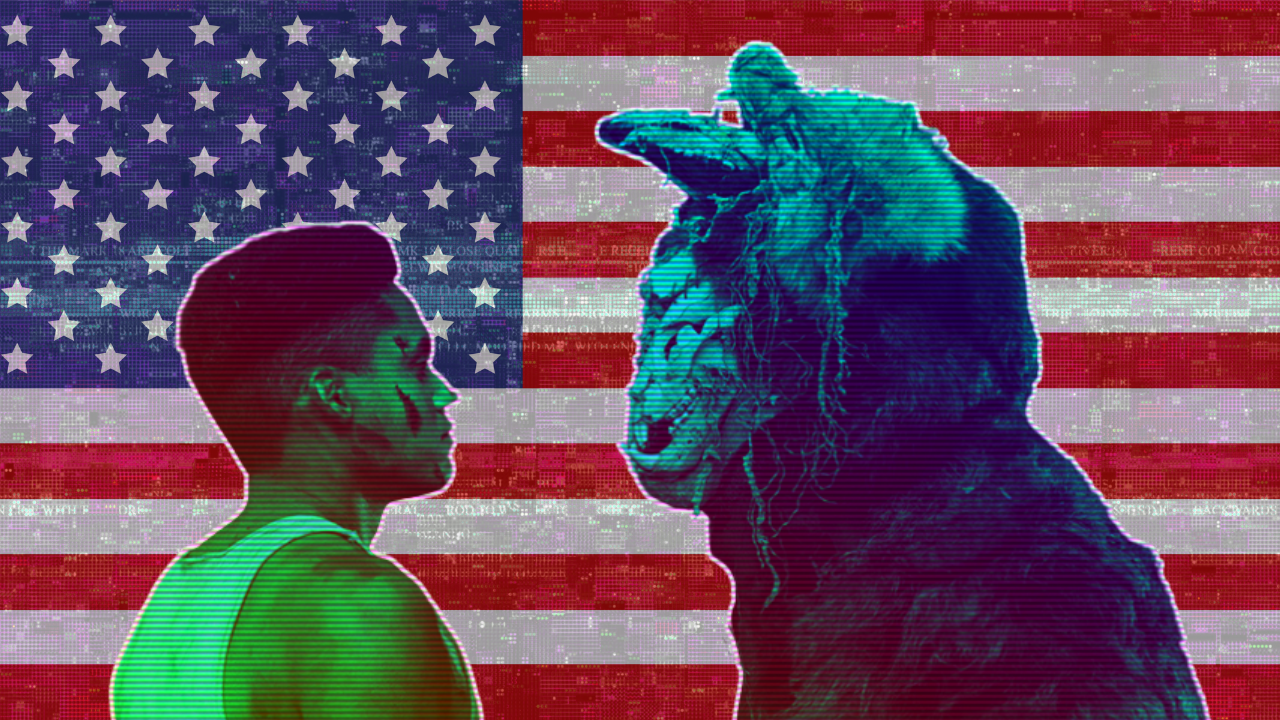
"Reject Modernity, Embrace Tradition"
The Wrong Turn film series ran its original premise from 2003 to 2014, sticking like glue to its cliches in the camping-trip-gone-wrong slasher genre, and being fully aware of it with each new installment. The original films introduced us to the Hillicker clan, consisting of homicidal inbred cannibal brothers Three Finger, Saw Tooth, and One Eye. Though their name and origins got established in later releases, audiences were reintroduced to the types of antagonists not seen since The Texas Chainsaw Massacre and The Hills Have Eyes, both remade within the same years as the initial run of Wrong Turn films.
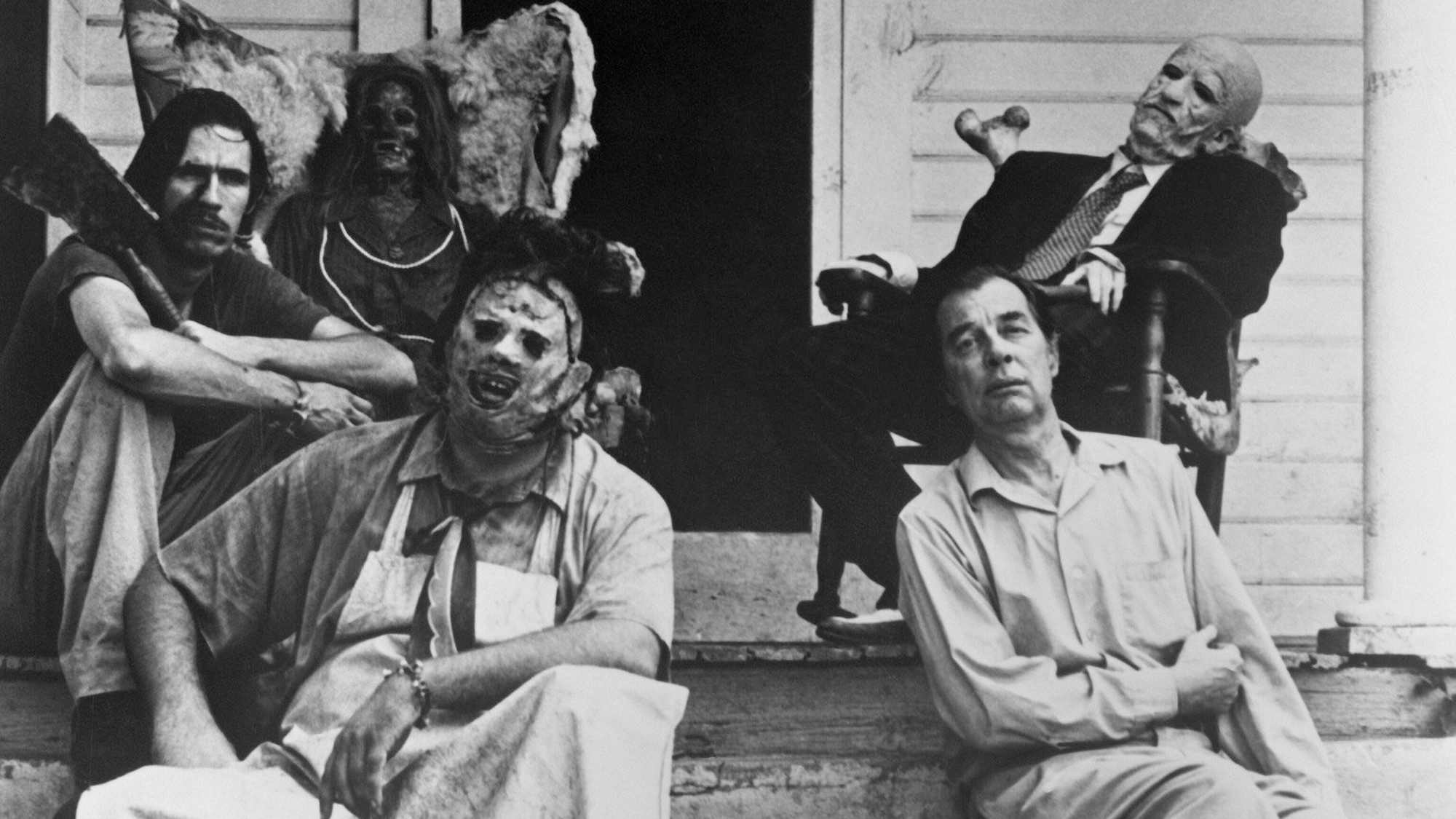
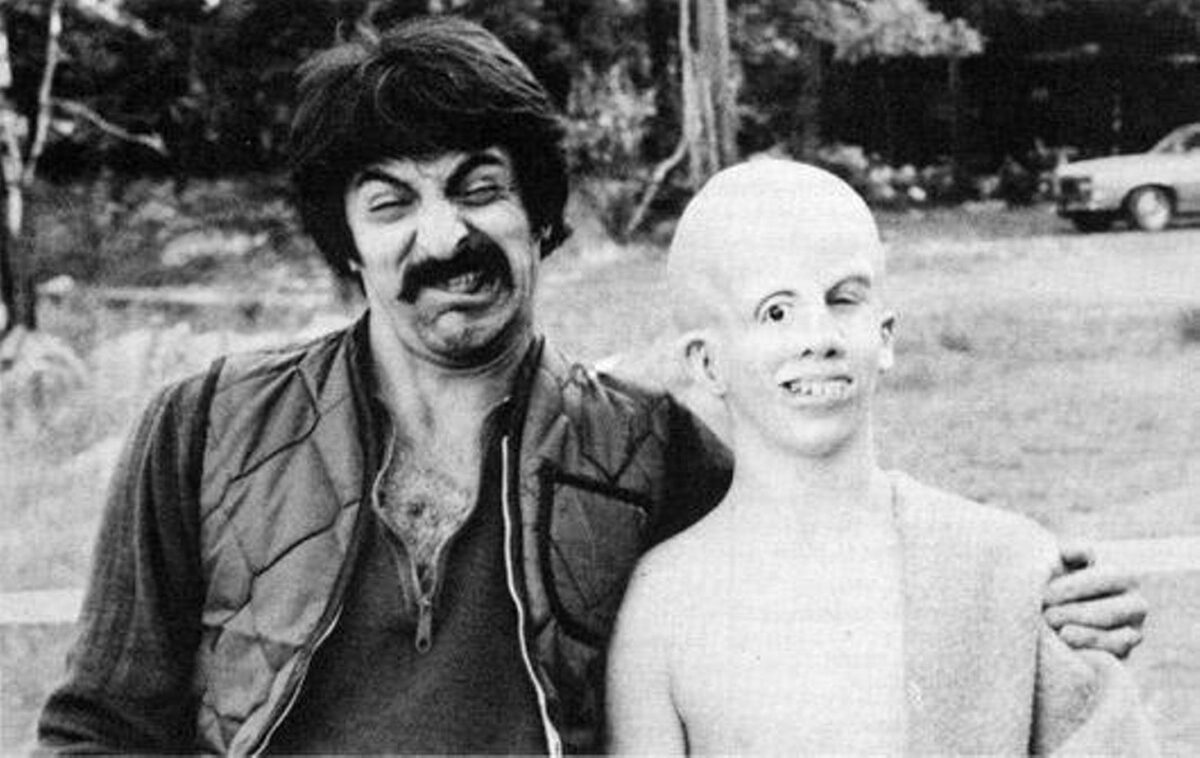
It's a tricky thing to ensure the lasting legacy of the deformed backwoods inbred cannibal as a horror villain. College kids just aren't taking unnecessary risks on hiking trips like they used to, and the more you learn about the origins of the stereotype, it becomes more tragic than horrifying. The trope stems from a commentary on America's discarded, ridiculed, and forgotten rural residents and America's internal xenophobia directed at their communities that have been left behind in the tides of American history. Tobe Hooper's The Texas Chain Saw Massacre (1974) serves as the gold standard of this dynamic, and the filmmaker knew who these characters were from their inception.
In an essay for the Texas State Historical Association, José Andrés Herrera Farías writes, "The movie's plot is fictional, but it was marketed as being based on a true story, a tactic highlighted in its promotional poster and opening narration. The decision to market the film as a true story was intended to captivate the audience, but it was also a response to the sociopolitical climate of the 1970s and reflected public skepticism toward the Richard M. Nixon administration and the media in the wake of the 1973 oil crisis, the economic recession, the Vietnam War, and the Watergate scandal. The film has been a subject of widespread critical analysis and commentary, with discussions exploring its themes relating to vegetarianism, familial dysfunction, violence against women, the displacement of rural workers in the face of industrial capitalism, hippie culture, and the clash between the rural South and the urban middle class."
The filmmakers of the Wrong Turn franchise knew damn well they were not reinventing the wheel. The series of movies happened to run alongside the Saw film series, creating a demand from coming-of-age horror fans to look for creative kills over political subtext. While Saw and Wrong Turn do offer some tin-foil baked sociopolitical readings, these films were not generating that kind of discourse for audiences right out of the theater. For the most part, audiences were very much in on the bit with the cast and crew that the goal was to see how many ways you can slice up an actor on screen. Years later, film scholars have looked back at this era of mid-to-big budget horror that seemed to hit theaters and direct release year-after-year with increasing curiosity, trying to make sense of the violent formula that did not seem to be even slightly tweaked along with the changing times.
That said, each installment in the Wrong Turn film series offered new revelations as to the origins of the Hillicker family, who were revealed to be products of inbreeding, and deformed from consumption of effluent. As mentioned, this archetype of the deformed horror villain is a familiar fan favorite, and is usually rooted in a more sympathetic backstory. Former summer camp attendee and hockey fan Jason Voorhees is the masked face of the Friday the 13th franchise, and is known for hacking camp counselors to bits in their more intimate moments with their partners.
The villain for the first Friday the 13th installment, as fans remember, was his mother, Pamela. Pamela explains that Jason was discarded and forgotten by two camp counselors as he drowned in the lake. Like the Hillicker siblings, the deformed villain in the horror film is enacting a legacy of revenge against the society that caused their deformity, or those that ignored them for their deformity. This narrative constantly reminding the audience of humanity's long struggle to build an all-inclusive society, regardless of physical differences, since time immemorial.
The Wrong Turn series concluded in 2014 and goes out on its own trademark hedonistic and gore-fueled terms, wrapping up the Hillicker saga, once and for all. In 2018, the original writer of the series' first installment, Alan B. McElroy, announced a reboot of Wrong Turn along with director Mike P. Nelson. In an interview for Fangoria, Nelson stated: "I was fully prepared on the first read to be thrust into a crazy slasher world of cannibals eating human flesh and splitting people down the middle. When that didn't happen, I was pleasantly surprised. There was something else at the core of the story that got me." McElroy's second iteration of Wrong Turn abandoned brash archetypal stereotypes of protagonists that the audience couldn't care less about, and are ultimately written for the wood chipper...literally. For this new reboot, our more familiar and modern cast of campers clash with tradition and culture.
This reboot gives more weight to the "NO TRESSPASSING" motif as a catalyst used in past installments for the plot of the entire series. This time, this warning reflects the ideas of individualism and community identity at the heart of a good portion of political and cultural strife seen today. The new film's plot begins in familiar territory, with Jen, her boyfriend Darius, and couples Adam and Milla, and Gary and Luis. They are on their way through rural Virginia to embark on the great Appalachian Trail hike. They stop to stay in a nearby town, where they kick off liberal versus conservative/urban versus rural discourse with the townsfolk at a bar, provoking and insulting the bar patrons. They then meet a woman and young girl, Edith and Ruthie, selling handmade crafts in town, before departing onto the mountain.
Almost immediately into the hike, McElroy and Nelson return to true Wrong Turn form. The hiking troupe triggers a series of traps that take out Gary and Milla. The remaining hikers discover that the trap-setters are hunters wearing handmade camouflage and animal skulls as masks. While cornered by the masked hunters, the hikers hear them speak in an unknown language, just as Adam kills one of the them before they are are trapped for good by another masked hunter. The group is then escorted as prisoners by Edith to a primitive compound deep into the forest, where they are brought before a group of elders led by a man named Venable to stand trial in their own archaic version of court.
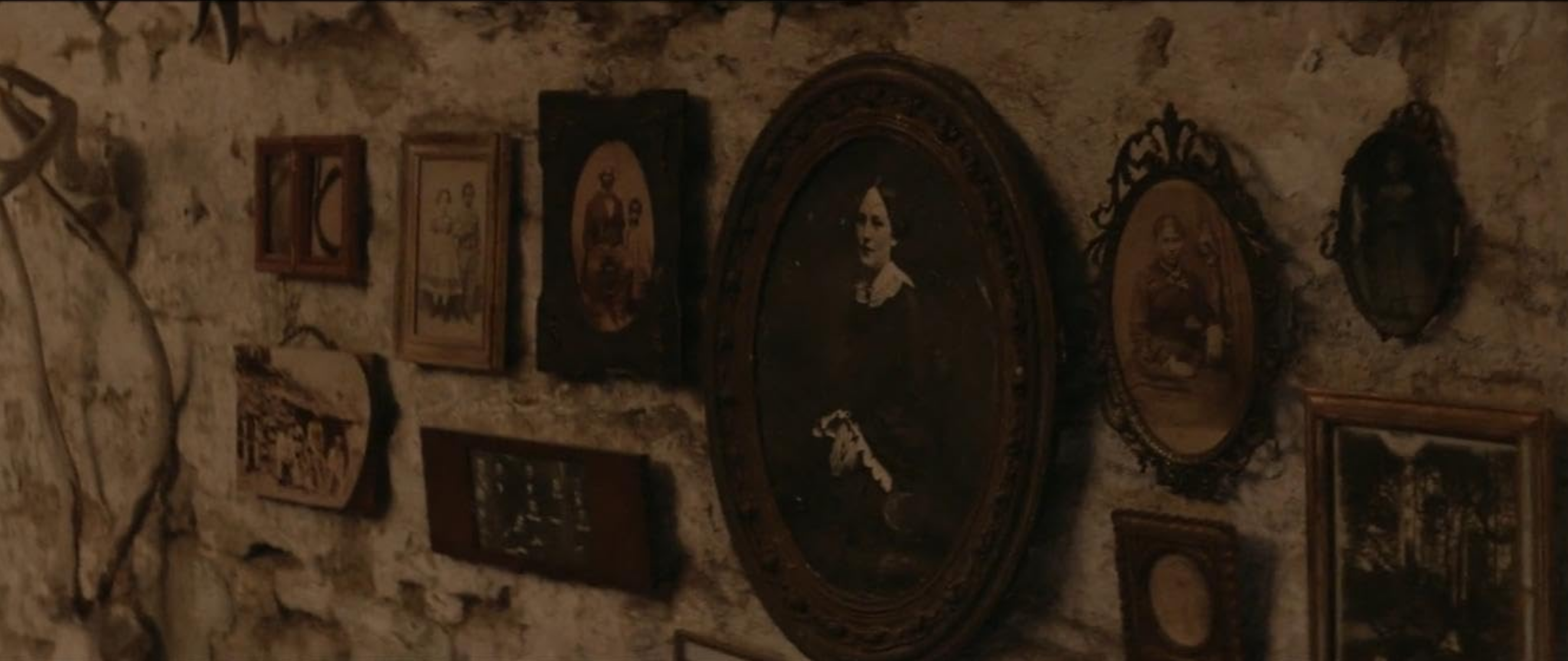
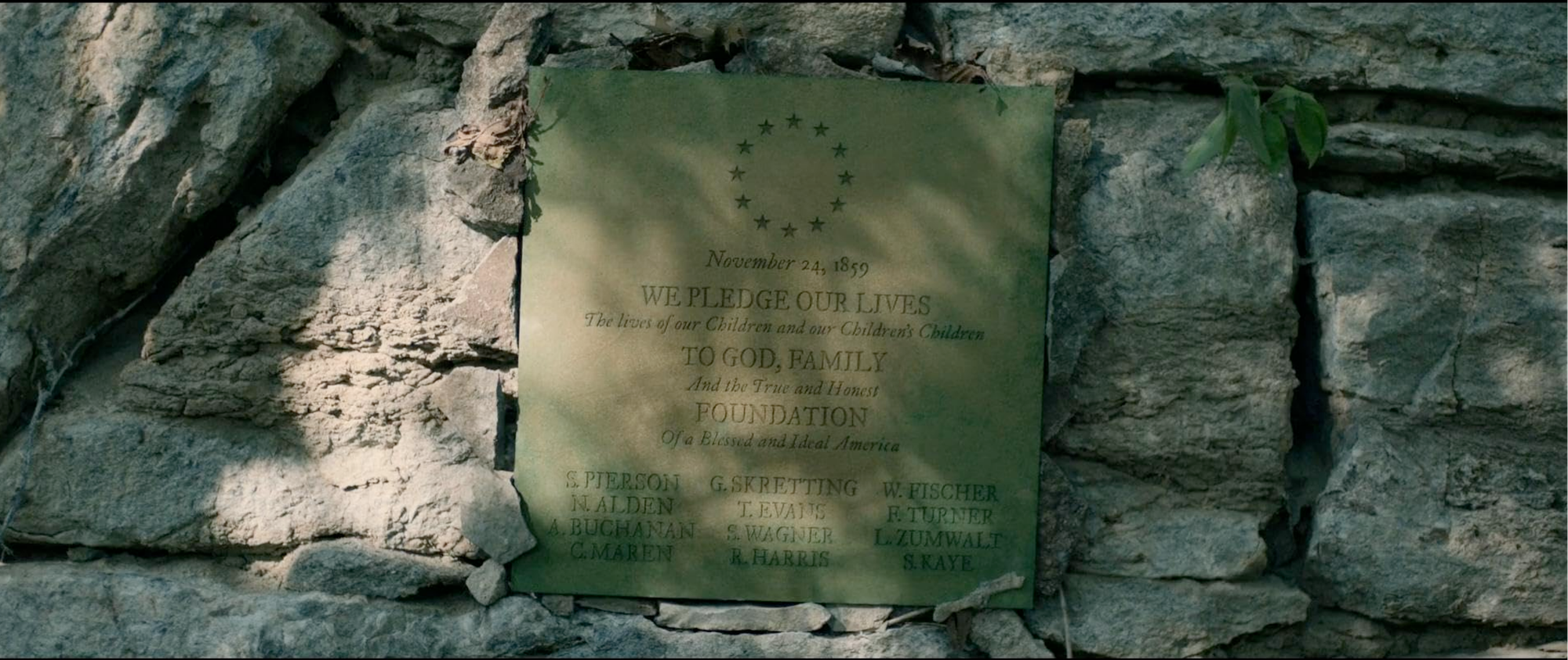
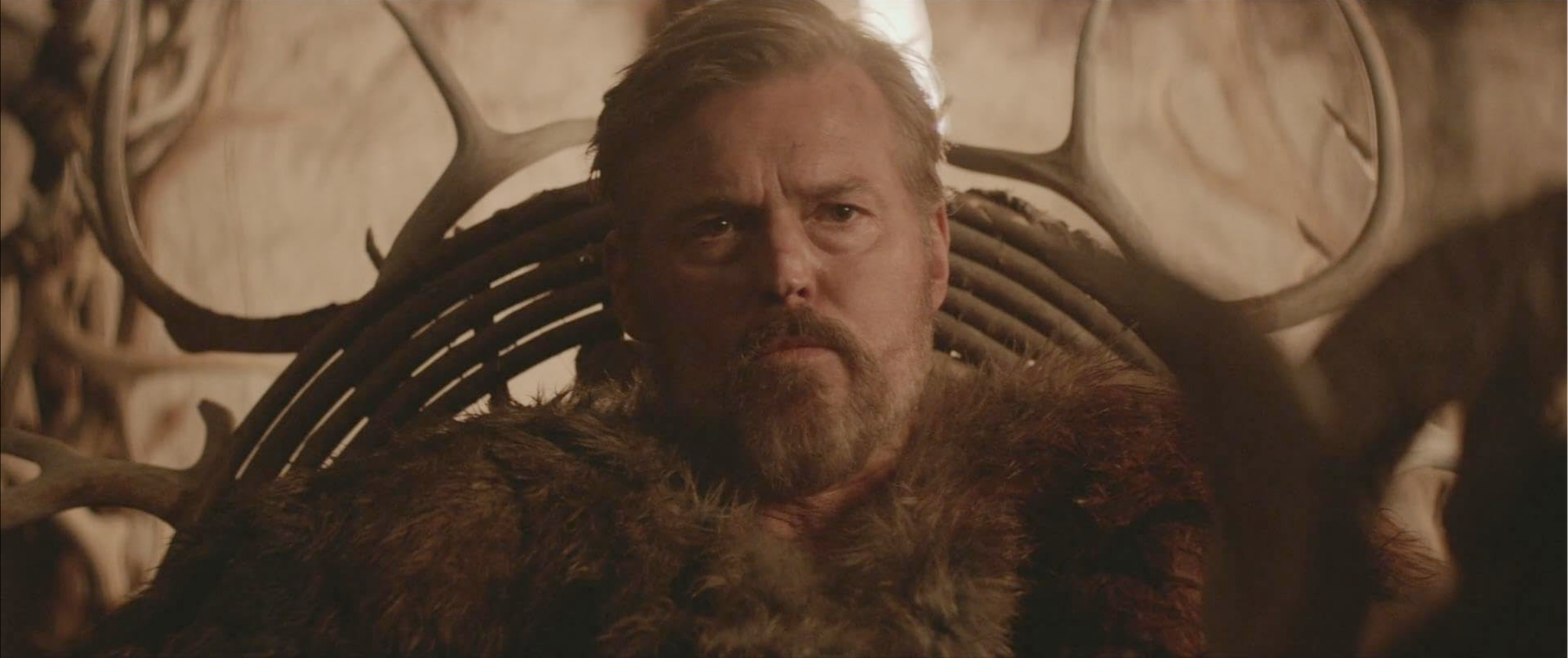
Venable reveals that Edith is his daughter, and that they are leaders of a group of fundamental primitivists known as "The Foundation". He states that they are descendants of multicultural Appalachian pacifists who retreated and separated from the United States in 1859, accurately predicting that the nation was on the verge of collapse. In response to Adam calling them "backwoods freaks", and Jen referring to them as "barbaric", Venable remarks that, unlike modern American life, everyone's work is valued, everyone contributes, and in return, they have fresh food, no war, no poverty, and no cancer in their civilization. He proclaims that they are true egalitarians who do not know hatred for one another. Jen, Darius, Luis and Adam are then found guilty of lying for Adam, and see him executed as a result.
McElroy's script in these scenes almost reads as repentance for his original antagonists being horrific caricatures of rural stereotypes. He tows a line going forward in the plot wherein Jen and Darius are spared for their willingness to join The Foundation as servants to the community. It is only when Jen's father, Scott, who had been searching for her for weeks, is captured by hunters and imprisoned within the compound that Jen, who agreed to marry Venable and offer herself as a healthy potential mother to his children, betrays The Foundation.
As they attempt to escape, Darius admits to wanting to remain behind, finally having felt acceptance within a community. McElroy chooses a clash of modern and primitive ideology for his remake as the core of his retelling without the need for the inbreeding and cannibalism rooted in an outdated stereotype to convey the horror of Wrong Turn. Although Venable allows them to live, Darius is made into a hunter, and Jen is made to be a mother for healthy children. So, for Venable to pitch their way of life as being better than the modern world, there are still some glaring archaic gender-based and hierarchical hangups they haven't worked out.
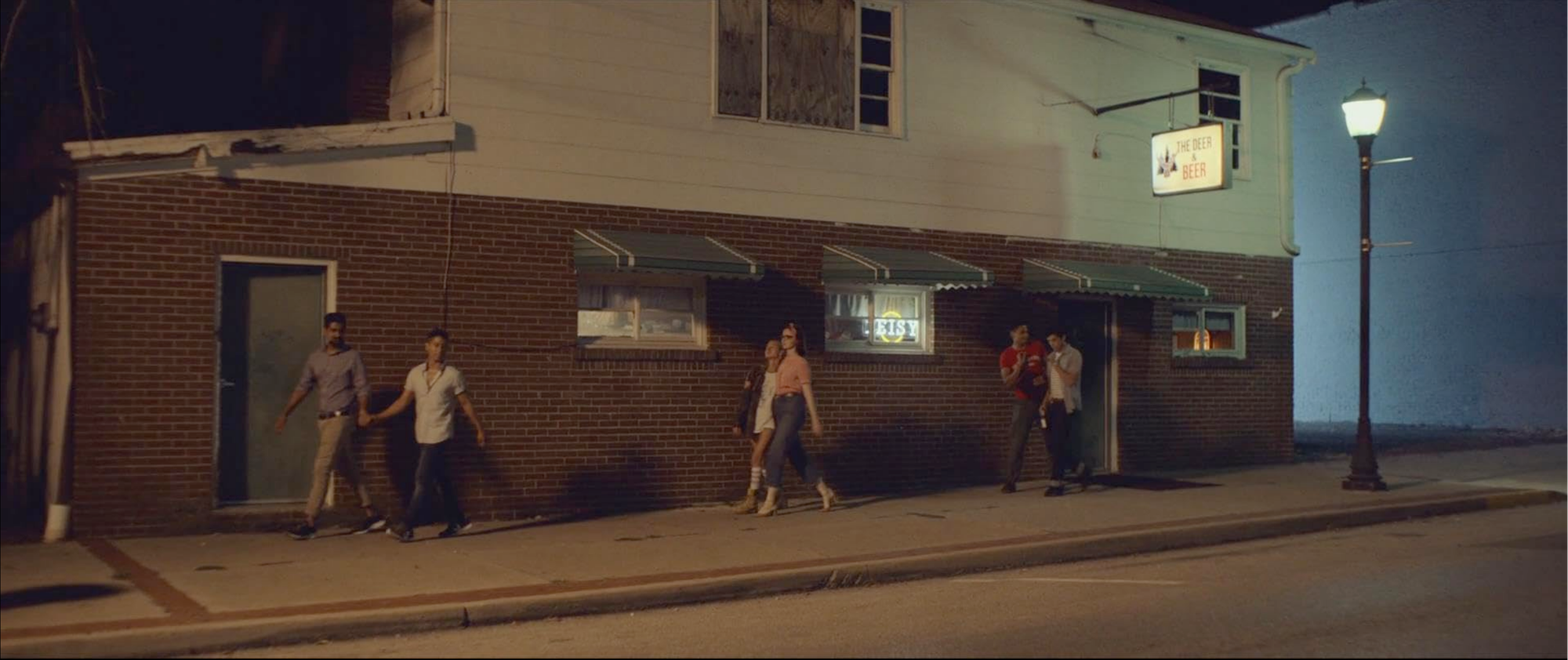
The victims of the original Wrong Turn series have been always been a mixed bag of flawed hedonists, who will definitely die, and more sympathetic morally-led characters, as is the slasher formula. This new retelling uses that same formula to examine class and political ideologies. In the scene at the bar, a local patron named Nate is put off by Jen and her friends' demeanor. The group of liberal suburban college students smugly counter his judgement with their own, stating their professional success in various progressive-leaning fields make them superior.
Later on, Nate and his crew assault Scott as he looks for Jen, trying to scare him out of town. A cop passes by as he is beaten to a pulp and refuses to assist. As Jen and Scott escape Venable and his compound, Nate arrives with armed townsfolk to help them escape The Foundation, citing his hatred for them being greater than his distaste for city folk, and belief that The Foundation killed his family member. They then sacrifice themselves to help Scott and Jen escape.
Wrong Turn works to retract its previous on-the-nose depictions of rural Appalachians by juxtaposing the Virginian residents with an only slightly scathing indictment of entitled liberal tourists, who enter the film's small town with nothing but contempt for its rural residents. As they roll into town, Gary mocks the town's appearance as "quaint", to which Adam responds, "Especially if you miss the days of the confederacy". Mind you, the only flag shown as they drive into town is the traditional Stars and Stripes.
Adam, a white man, is shown to be constantly suspicious of the town's imagined racism, whereas Darius, who is black, corrects his ignorance, mentioning that the town is noted for its abolitionist history. In the 2003 original film, it was a layup to depict urban versus rural stereotypes without any subtext, but McElroy goes that extra step to capture our current political climate, in which the often unaddressed liberal animosity and dismissal of working class people is doing constant harm to building stronger communities.
The film does solid work of differentiating it's character grouping to convey a message of combative ideologies that have existed for generations in American society. While Nate and the citizens of the town are portrayed as modern conservatives, they admit to knowing and fearing Venable and The Foundation, who have no problem with justifying kidnapping, murder, and using their kangaroo court to sentence trespassers to forced-blindness and immurement within the cave systems. To The Foundation, this is how they ensure the survival of their primitive culture. As stated, The Foundation has no concepts of racism or xenophobia, as their founding was in direct response to the fracturing of the country on the concept of slavery in the years leading to the American Civil War. Although, as we saw in the film, capturing female hikers and permitting them to escape imprisonment only by agreeing to exist only as breeding vessels is apparently on the table.
The online phrases "Reject Modernity, Embrace Tradition" and "Retvrn" are well known neofascist LARPing shitposter phrases that have roots in the very real ethnonationalist and conservative fundamentalist corners of the web. These ideologies have unfortunately left those corners within the last decade or so, and have been embraced by far-right media, who appreciate the online backlash to feminism, multiculturalism, and acceptance of queer communities. Many notable outlets and pundits on the far-right use their verbiage and sentiments to continue stoking sociopolitical tensions in our country. They share similar hopes of creating communities akin to the type built by The Foundation, but inversely, where the more they see the embracing of one's neighbor regardless of race, creed, gender, or sexuality, the closer to the collapse of civilization they feel. Many also express desires similar to The Foundation's gender-essentialist ideas of men as hunters and women as mothers to ensure a sound civilization.
In the US, a far-right ethnonationalist group established a separatist community in a remote region of northeastern Arkansas known as Return to the Land (RTTL). The group opened its first community in October of 2023 only to individuals with traditional values and descended from European ancestry (white). To quote the group article that documented their plans to potentially expand into Missouri, "The group is opposed to mass immigration, multiculturalism and “forced integration” and reportedly does not welcome non-white, non-Christian or LGBTQ+ people, explaining that its members are seeking to “separate ourselves from a failing modern society” and return to pastoral living." These are The Great Replacement Theory's most devout believers. Now, the white supremacists of RTTL have not harmed any trespassers in the surrounding woods, but as we saw with The Foundation in Wrong Turn they are explicit with their intention to exist within, but adamantly separate from American society, with their own law taking precedent over the US constitution.
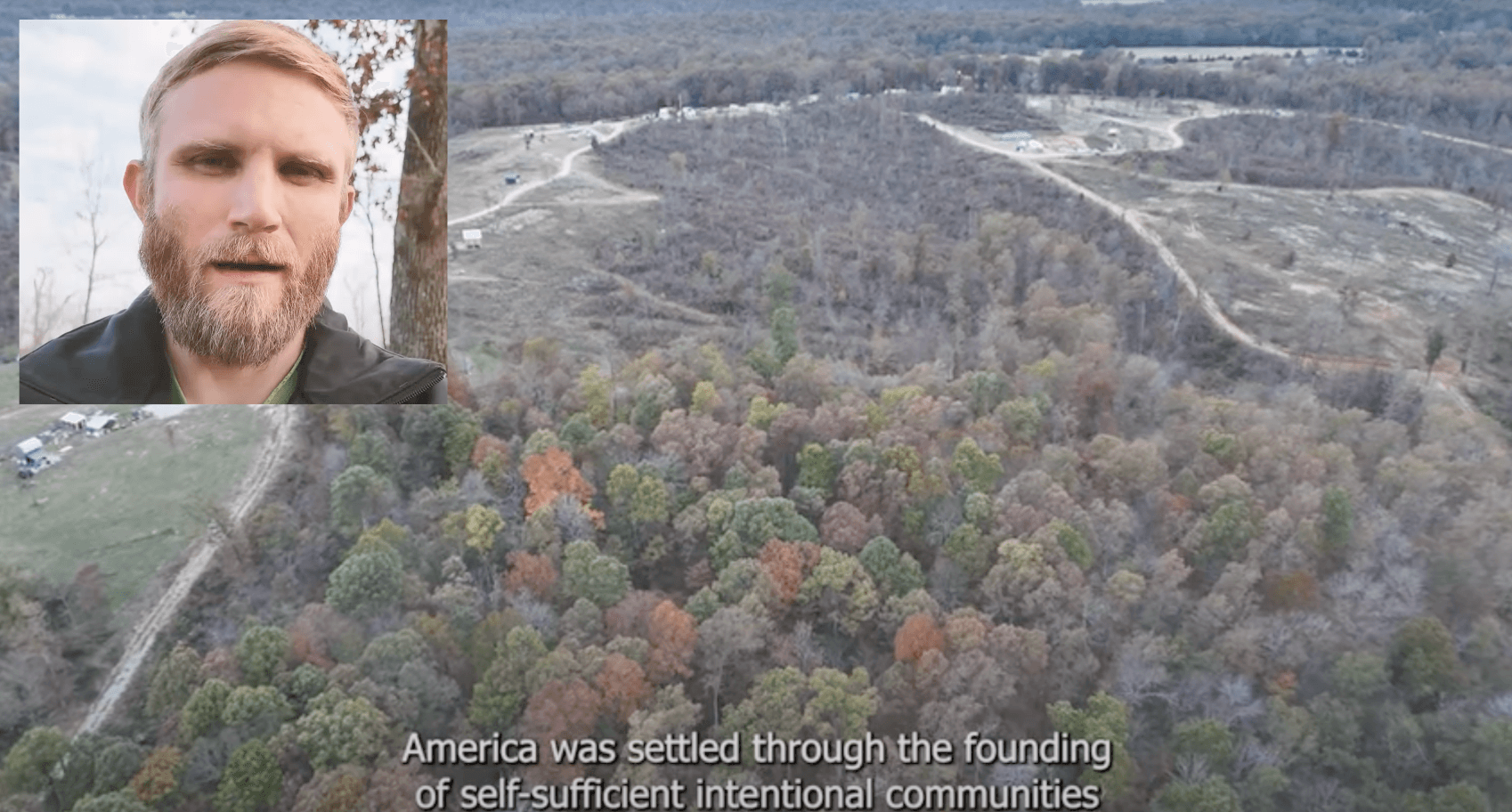
If 2003's The Texas Chainsaw Massacre and 2006's The Hills Have Eyes were remakes that set out to be homages and faithful retellings, while doing only some work to undo and unpack their villain's backstories, McElroy and Nelson have actually managed to reinvent their own wheel that first rolled in 2003. 2021 was only memorable and notable for all the wrong reasons. We saw communities turn on one another, and neofascist extremism find its footing in the minds of those who harbor resentment of their own country. Instead of going back to outdated characters in familiar settings, the filmmakers found inspiration to reignite an all-but-forgotten slasher set in the woods as a warning of what contempt of community and country could look like. While films like Ari Aster's Eddington are recent attempts to unpack what went wrong, Wrong Turn was the horror genre's unique look at what had already been going wrong for quite some time.
Happy Halloween.